
I bet a lot of you have heard a lot of things about meditation and mindfulness. Maybe your doctor has mentioned these things, maybe you’ve seen them in various health pamphlets before. Or perhaps you’ve delved into Buddhism or self-help practices. Whatever the case may be, you surely have noticed that these concepts are gaining a lot more sway and credence in the average Western healthcare system. These are presented as means by which we can “fix” things such as mental health issues, or gain a better outcome if we have something like hypertension. But what are these things exactly, you may be asking? Can they actually be of benefit? If so, how could they actually benefit me?
Meditation and mindfulness: What are they exactly?
To put it briefly, mindfulness is the nonjudgmental acceptance of the everyday. If you’re upset? You’re upset. If you’re doing dishes? You’re doing dishes. That should be the point of focus, if you are practicing mindfulness. So much for what may be a popular misconception around mindfulness, as something perhaps practiced by some chakra-obsessed wraith called Windsong… breathing in and out and focussing on channeling “good vibes only”. Mindfulness can be quite tough, more often than not it’s about realism. Sometimes we can want to escape the everyday, and that is cool too- we can mindfully accept that, but then bring it back to what we are needing to do here and now.
This is based on Buddhist practice, which in turn originated from the Hindu tradition. Buddha changed things up because he had once been a very severe ascetic, in the old tradition- which in Hinduism is not necessarily recommended either. However, Buddha placed the emphasis on obtaining a middle path between extremes. This is mindfulness too, not striving towards perfection- but chilling on ourselves when we make mistakes. Not being loose with ourselves and our lives, but making an effort to make good choices.
I personally find this very interesting in terms of the brain. We have a right brain and a left brain, that most of us know. However, what many of us do not know is that there is also something called the corpus callosum which joins the two. Having a healthy middle to our brain can increase our functioning under stress, and our ability to perform complicated tasks. Perhaps practicing a balance of our instincts, our creative longings and our rational thinking can help us have better, healthier brains? I’ll dig into this some more later on.

But enough about mindfulness. What is meditation? That’s the thing that a practitioner will sit down and do. It can take many different forms for different people, but the most common (and the most powerful, in my opinion) is a simple focus on the breath. This itself has been practiced for many thousands of years. It works because the breath moves- and the mind moves. Keeping the mind of a fixed object is going to be more difficult.
Some people will chant, pray, do breathwork with their meditation. I’m those people. I have spiritual beliefs which are important to me, and the breathwork can help calm the nervous system. Others may simply choose to focus on bringing their positive intention to those who they love. It really doesn’t matter what you connect to in meditation, as long as it is meaningful to you.
How can it be of benefit?
It’s a little bit tricky to study meditation and mindfulness and its effects on the brain, because there are so many ways of practicing these. However, it’s not too difficult to get ahold of someone like a Buddhist monk and do some scans on their brain. No study is perfect of course; there could be other lifestyle factors that lead to these results. But these results do show that the brains of practitioners are younger, healthier, and better attuned to rational decision making. A higher degree of activation of the prefrontal cortex in these brains illustrates this, along with a higher density of grey matter.
Other studies centered on individuals with mental health issues who have undergone meditation and mindfulness training report an improvement in symptoms long after the training has ceased. Most importantly, executive functioning is strongly affected. This means that these people benefit from an increased ability to make plans and stick to them, and to moderate their own thought processes.
Let’s look at a slightly gruesome example of the power of meditation.
The Burning Monk.
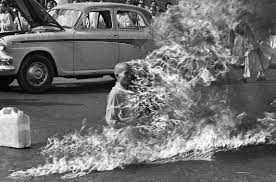
You may or may not know this image. This is a monk called Thich Quang Duc, who burned himself to death in order to protest the treatment of Buddhists in Vietnam. The act, in and of itself, is a quiet testament to the power of Buddhist practice. This is as if to say “do not oppress us, look what we are capable of.” Indeed, what happened to the US army in Vietnam?
This man, over many years, cultivated the ability to co-exist peacefully with pain. He learned breathing techniques that can bring stamina and fortitude under great pressure. He also cultivated the ability to be master over his own mind, to not run screaming because of instinct but to sit calmly as an act of will.
Imagine how these qualities could help us on a journey of body and mind healing! Not letting our discomfort rule us, but letting that be the other way around. The capacity to not respond immediately to impulse, but to make clear and wise decisions that serve us well. If nothing else, perhaps we could achieve the ability to be at peace in difficult situations. Also, we could learn to work patiently and gracefully with what we are blessed to have already.
As the Buddha himself said:
“I will teach the destination, and the path leading to the destination. Listen to what I say. What is the destination? The eradication of infatuation, the eradication of hostility, and the eradication of delusion are what is called the destination. And what is the path leading to the destination? Present-moment awareness directed towards the body. This awareness is what is called the path leading to the destination. In this way, I have taught to you the destination and the path leading to the destination. That which should be done out of compassion by a caring teacher who desires the welfare of his students, I have done for you.” (Parayanasutta, 2007)
Please follow the links below for further reading!
Manno, F.A.M (2019). Monk on fire: The meditative mind of a burning monk. Cogent Psychology, 6:1, DOI: 10.1080/23311908.2019.1678556
 Green Lady Astrology